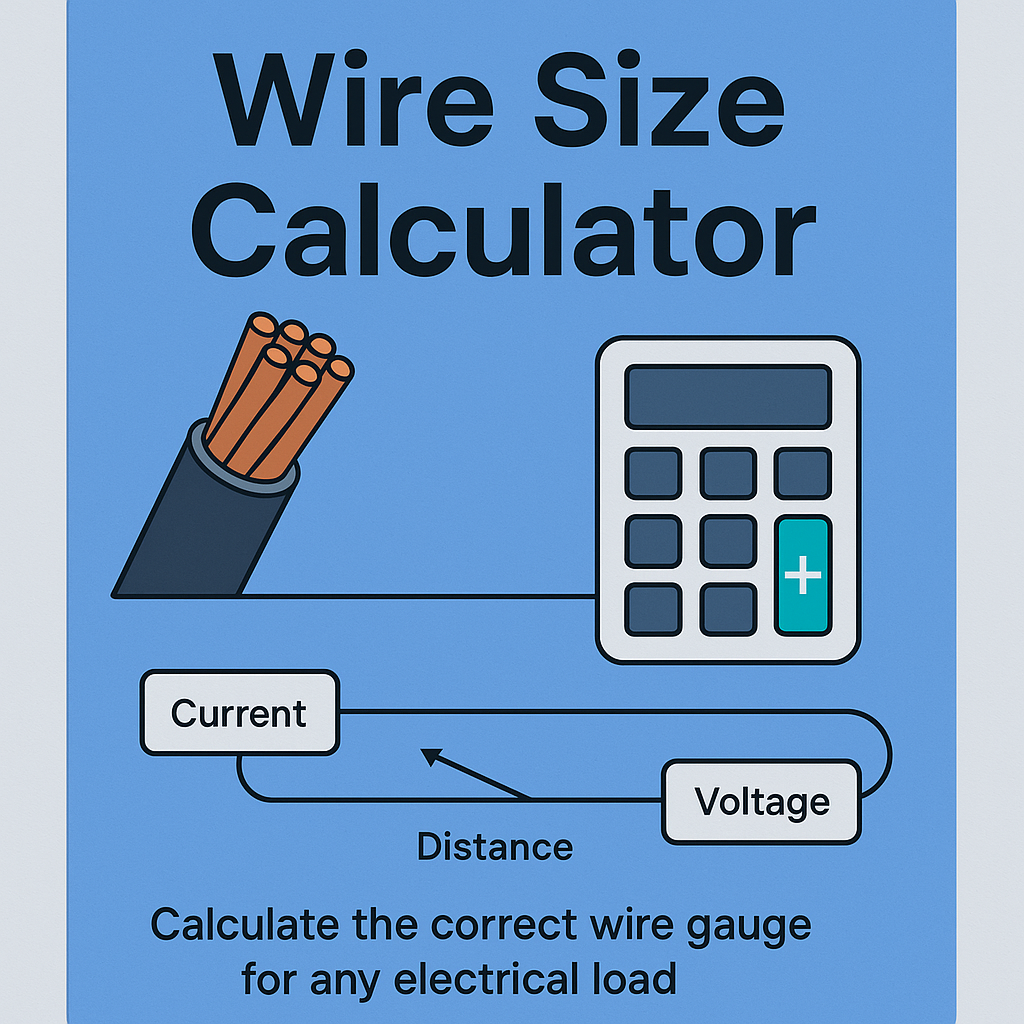
Wire Size Calculator – Choose the Correct Wire Gauge Safely
✅ Wire Size Calculator – How to Choose the Right Wire Gauge Safely
Choosing the correct wire size is one of the most important steps in designing any electrical system. Whether you're wiring a house, upgrading a car audio installation, building a solar setup, or running cables on a boat, selecting the wrong wire gauge can lead to overheating, excessive voltage drop, equipment malfunction, or even a fire hazard.
Our Wire Size Calculator helps you quickly determine the ideal wire gauge (AWG or mm²) based on current load, voltage, cable length, and acceptable voltage drop. To fully understand how to size wiring correctly, this guide will walk you through the principles behind the calculator and explain why proper wire dimensioning is essential.
🧠 What Wire Size Actually Means
Wire size refers to the thickness of the conductor and is expressed in two systems:
AWG (American Wire Gauge) — the smaller the number, the thicker the wire
mm² (cross-section area) — used in most international standards
Wire size determines how much electrical current the cable can safely carry without overheating. A wire that is too thin creates resistance, which leads to:
heat buildup
voltage loss
lower device performance
unnecessary strain on power supplies
reduced lifespan of electronic components
In extreme cases, a cable that is too small may melt or ignite.
On the other hand, choosing a wire that is unnecessarily thick increases installation cost and makes routing cables more difficult. The goal is to find the optimal size — not too small, not too large.
⚡ How the Wire Size Calculator Determines the Correct Gauge
Our calculator uses four fundamental inputs to calculate the proper wire size:
1️⃣ Electrical Load (Amperage)
Every device draws a specific amount of current. Higher current requires a larger wire since more electrons moving through the conductor generate more heat.
2️⃣ System Voltage (12V, 24V, 110V, 230V, etc.)
Lower-voltage systems are more sensitive to voltage drop.
For example:
A 3% voltage drop on 230V is barely noticeable.
A 3% drop on 12V can cause lights to dim or electronics to malfunction.
This is why solar, automotive, and marine systems often require much thicker cables than household wiring.
3️⃣ Cable Length (Round Trip)
Electricity must travel to the device and back, so the calculator uses round-trip distance.
Longer cables have higher resistance, which increases energy loss.
4️⃣ Allowed Voltage Drop (%)
Recommended guidelines:
3% for sensitive electronics
5% for general home circuits
10% for some low-voltage or non-critical systems
The calculator applies Ohm’s law and standard copper resistance values to determine the smallest wire size that will:
✔ prevent overheating
✔ keep voltage drop within limits
✔ ensure optimal device performance
🔌 Common Wire Gauge Reference Table
Current (A)Recommended AWGRecommended mm²5A20 AWG0.5 mm²10A16 AWG1.5 mm²15A14 AWG2.5 mm²20A12 AWG4 mm²30A10 AWG6 mm²40A8 AWG10 mm²60A6 AWG16 mm²
These values are general. The calculator offers precise results tailored to your exact installation conditions.
🧰 Where This Calculator Is Especially Useful
The Wire Size Calculator is commonly used for:
Solar power and battery systems
RV and camper electrical upgrades
Marine wiring (12V/24V boats and yachts)
Car audio amplifiers and LED lighting
Home renovations and electrical circuits
Off-grid cabin installations
DC and AC wiring projects
Anyone working with electrical systems can benefit from quick, accurate wire sizing.
🛡 Safety and Performance Benefits of Choosing the Correct Wire Size
✔ Improved energy efficiency
Larger wires have lower resistance, reducing heat and power loss.
✔ Stable voltage levels
Electronics—especially LED drivers, pumps, controllers—work best at consistent voltage.
✔ Longer component lifespan
Lower stress on electrical devices results in fewer failures over time.
✔ Reduced fire risk
Proper wire sizing is the strongest protection against overheating.
✔ Ensures compliance with electrical standards
Many safety codes require specific wire sizes for given loads.
❓ Frequently Asked Questions (FAQ)
What happens if the wire is too small?
It overheats, causes voltage loss, and can damage your equipment or even cause a fire.
Does cable length matter for wire sizing?
Absolutely — the longer the cable, the greater the resistance and voltage drop.
Are AWG and mm² equivalent?
No. AWG is a gauge number system, while mm² measures physical cross-section. The calculator converts between the two.
What is an acceptable voltage drop?
3% for sensitive electronics
5% for most household circuits
Up to 10% for non-critical low-voltage systems
Can I use a larger wire size than required?
Yes, it is always safe — but usually more expensive and not necessary.